Color cosmetic OEM is a different factory conversation than skincare OEM. The differences show up in three places first: the base system, which is often anhydrous or emulsified instead of water-based; the filling and forming process, which uses mold pouring and powder pressing instead of standard filling lines; and the color logic, which brings shade batch control measured in Lab values, market-specific colorant rules and packaging that rarely transfers between products. A brand moving from skincare into color will find that most of its skincare assumptions need re-checking in exactly these areas.
Which three differences should you check first?
Base system, forming method and color control. Everything else in a color project follows from these three.
Skincare formulas are mostly water-based emulsions: water phase, oil phase, emulsifier, actives. Color cosmetics frequently work the other way around. An anhydrous base of waxes, oils and esters carries the pigment in bullets and lipsticks; pressed powders are largely dry systems built on pretreated pigments and pearlescent pigments. The formulation skill set overlaps less than a shared product shelf suggests.
That difference drives the rest. An anhydrous or powder system does not fill like an emulsion, does not test like an emulsion and does not fail like an emulsion. When you compare factories, compare them on the format you actually make, not on "cosmetics manufacturing" in general.
| Aspect | Typical skincare OEM | Typical color cosmetic OEM |
|---|---|---|
| Base system | Mostly water-based emulsions | Often anhydrous wax or oil bases, or dry powder systems |
| Filling and forming | Filling lines for liquids, creams and gels | Mold pouring for lipsticks, powder pressing for pans, tube filling |
| Batch control focus | Stability, viscosity, pH, microbiological quality | Shade match in Lab values, texture, payoff |
| Packaging | Bottles, jars and pumps with broader cross-use | Bullets, pans, compacts and molds; low interchangeability |
| Regulatory focus | Ingredient restrictions and claim rules by market | Colorant lists and approvals by market, plus heavy-metal and microbiological limits |
If you are mapping a full line rather than a single SKU, the staging logic from planning a private label line still applies; only the format-specific steps change.
Why is pigment pretreatment and dispersion the core process?
Because in a color formula, dispersion is the product. Pigments and pearlescent pigments determine the shade, the opacity and how the product applies, and they only perform if they are distributed evenly and stably through the base.
Pigments typically arrive as fine powders that need pretreatment and controlled milling or dispersion before they enter the batch. Under-dispersed pigment shows up as specks, weak payoff and shade drift between batches; over-processing can shift the color itself, because milling changes particle size and pearlescent effects depend on particle geometry. In practice, the dispersion step sets the ceiling on quality for everything downstream: two factories working from the same formula sheet can deliver visibly different products if their dispersion equipment, milling parameters and batch discipline differ.
What this means for your side of the conversation: ask how the factory handles pigment pretreatment, what milling or dispersion equipment it runs, and how it verifies that a batch is fully dispersed. These answers separate a dedicated color manufacturer from a skincare line that occasionally fills a tinted balm.
How does filling change with the product format?
Filling in color cosmetics is closer to molding than to pouring. The method follows the format:
- Lipsticks and bullets: the molten base is poured into molds, cooled, then released. Demolding, shrinkage control and surface finish are the recurring process questions.
- Pressed powders and pans: the pigmented powder blend is pressed into pans or compacts. Pressing force, pan fit and breakage resistance matter more than flow behavior.
- Cream and liquid color: closer to conventional filling, but shade verification still happens per batch.
For production planning, this changes your assumptions about changeovers. A pressed-powder line and a lipstick line are different equipment families, and one factory may run some formats in-house while subcontracting others. That directly affects MOQ structure, lead time and what a "shared base" can realistically mean across your shade range. Ask early which formats run in-house, and plan your first order around the formats the factory actually controls.
How do you set shade batch control with Lab values and tolerances?
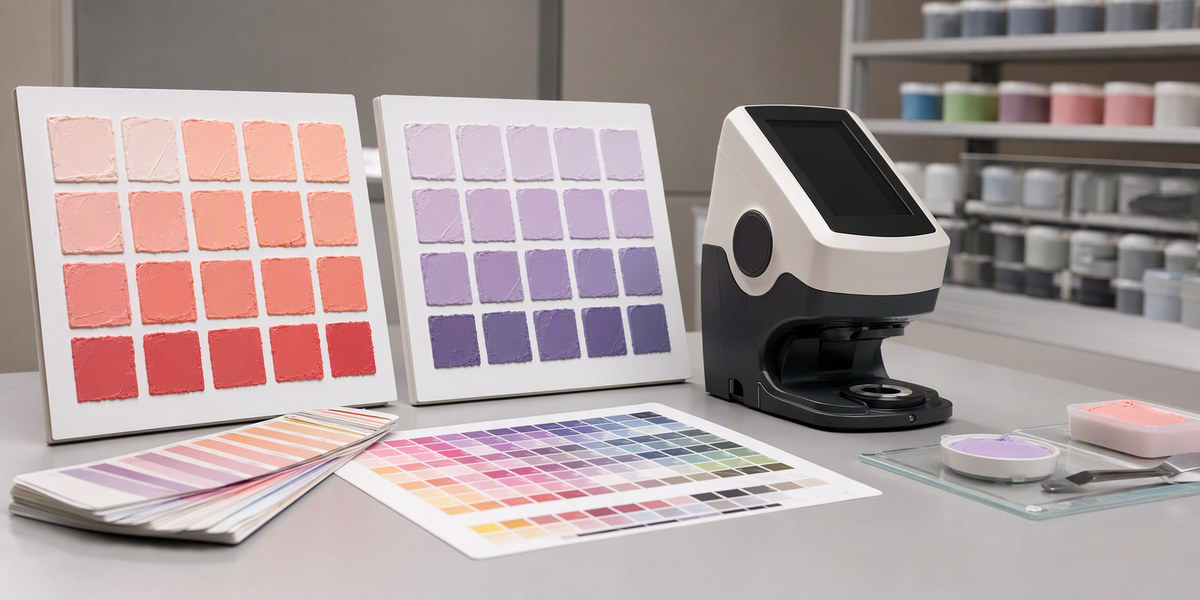
Shade control is the quality system skincare lines usually do not need. Color products are accepted or rejected against a reference shade, and the industry measures that shade in CIELAB Lab values: L for lightness, with a and b for the color axes. A batch is on shade when its Lab values fall within an agreed tolerance of the standard.
The tolerance itself is a commercial decision, not a universal constant. It is set by your brand standard, by the visual difference your customer will notice, and by how stable the process is in practice. A mass-market lip tint and a premium artist palette will not carry the same tolerance. What matters operationally is that the tolerance, the measurement method and the reference standard are agreed before the first production run, and that every batch is measured against that standard and recorded.
Shade batch records are also what let you investigate later. If a reorder comes back slightly off, the Lab history tells you whether the drift came from the pigment lot, the dispersion or the filling. Keep the standard sample, keep the per-batch records, and define who signs off on an out-of-tolerance batch before you need the answer.
How do you handle colorant rules across different markets?
Colorants are one of the most market-specific parts of a color formula. The same pigment can be a permitted color additive in one market and a restricted one in another, so the compliant palette is built market by market.
- European Union: colorants are managed through a positive list in the EU cosmetics framework (Annex IV); a colorant needs to be listed and used within its conditions to be used in EU products.
- United States: color additives require FDA approval for their intended use, and the approved list and its conditions are what you check a formula against.
- China: colorants are governed by the Safety and Technical Standards for Cosmetics, with their own permitted sets and limits.
Heavy-metal and microbiological limits also differ by market. None of this transfers automatically: a palette that is compliant for the EU is not thereby compliant for the US or China. For export projects, confirm the target-market colorant status of every pigment and pearl before the formula is locked, because a late substitution changes the shade and restarts your batch control work.
What should you ask during quoting and sampling?
The quoting and sampling stage is where a color project succeeds or quietly accumulates risk. Bring these questions:
- Which formats run in-house, and which are subcontracted?
- How is pigment pretreatment and dispersion handled, and how is full dispersion verified per batch?
- How is shade measured — which instrument, which Lab tolerance, and who owns the reference standard?
- What packaging does this format require, and how interchangeable is it across your shades?
- Which colorants in the formula are approved for each target market, and what happens if a substitution is needed?
- What does the quotation cover — sampling, trials, mold or pan tooling, and per-SKU changeovers?
Items 4 and 6 deserve the same scrutiny as in skincare: the cost structure of a color line lives in tooling and changeovers, and the habits from reading an OEM quotation apply directly. Before the first run, fold these answers into the standard checks before the first production run, and put the shade standard, the batch records and the formula terms under the same confidentiality and exclusivity terms you would use for any custom formula — a signature shade is part of the product’s value.
If you are scoping a color cosmetic line and want to align on the process route, shade control and colorant compliance for your target markets before sampling begins, our technical team can review the brief with you.