Before a skincare formula goes into mass production, it typically clears three rounds of testing: stability, preservative challenge, and in-use efficacy. Of these, stability testing sets the pace, usually three to six months of accelerated data, while the other two can partly overlap with it. In a smooth project the whole package takes about four to six months; if the formula fails mid-way and has to be reworked, the clock resets.
What Does Skincare Formula Testing Actually Cover?
The three tests answer three different questions, and conflating them is one of the most common mistakes we see in project plans.
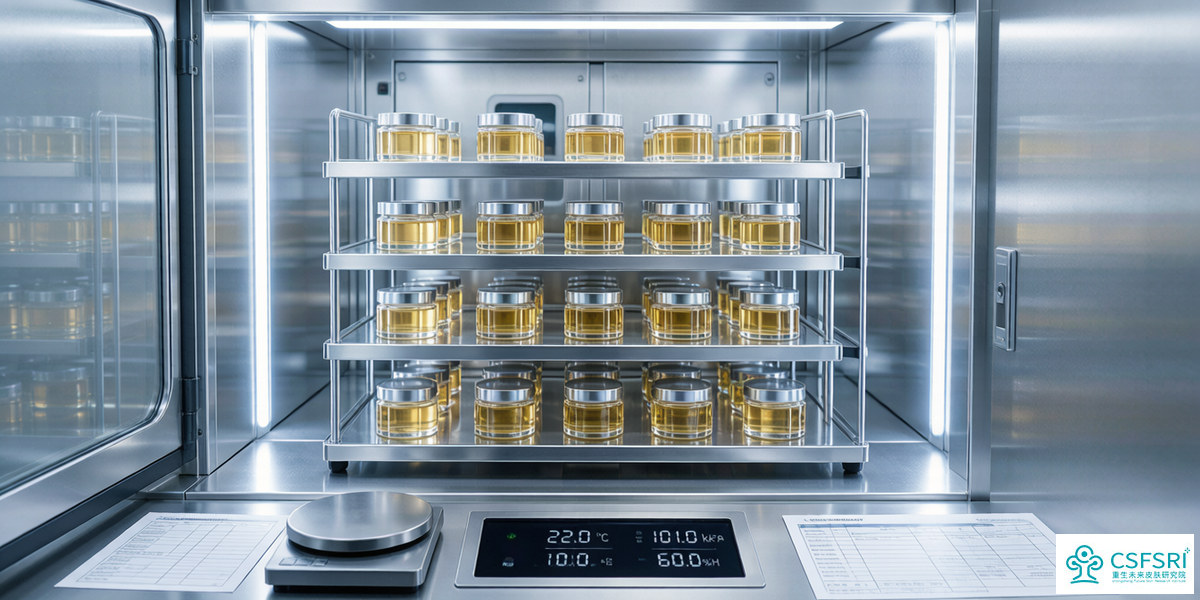
- Stability testing asks whether the formula stays physically and chemically intact over its shelf life, under heat, light, and time. You are looking for phase separation, color shift, pH drift, viscosity change, and off-odors.
- Preservative challenge testing (also called preservative efficacy testing, or PET) asks whether the antimicrobial system holds up after a consumer opens and uses the package over weeks. It is done by inoculating the formula with representative bacteria and fungi and counting survivors over a set period.
- In-use efficacy testing asks whether the claims you want on the pack, such as moisturizing or improving the look of fine lines, can actually be supported with data from real volunteers.
Each test has its own method, its own timeline, and its own cost. A contract manufacturer that quotes a single "testing fee" without breaking these apart is worth questioning.
How Long Does Each Test Take?
The timelines below are typical ranges, not guarantees. Real numbers depend on the lab, the formula type, and how many time-points the protocol calls for.
| Test | What it measures | Typical duration | Standard reference |
|---|---|---|---|
| Accelerated stability | Physical/chemical integrity at 40C / 75% RH | 3 to 6 months | ISO TR 18811, ICH guidelines |
| Long-term (room temp) stability | Shelf-life support data | 12 to 24 months (runs in parallel, rarely blocks launch) | ISO 22716 context |
| Preservative challenge | Microbial control over repeated opening | 4 to 8 weeks | ISO 11930, USP <51>, Ph. Eur. 5.1.3 |
| In-use efficacy | Claim support on volunteers | 2 to 12 weeks, depends on claim | Varies by claim and market |
A few things worth noting. Stability is the long pole. Three months of accelerated data gives a preliminary read; six months is what most brands want before committing to a production run. Preservative challenge testing is comparatively quick, because the core observation window is 28 days. Efficacy testing scales with the ambition of the claim: a basic hydration measurement can wrap up in two to four weeks, while anything about the look of wrinkles or firmness usually needs eight to twelve weeks to produce a defensible data set.
Which Tests Can Run in Parallel?
This is where most brand-side timelines go wrong, because the three tests are not strictly sequential.
Stability and preservative challenge testing can start at the same time, on the same pilot batch. They do not depend on each other. So the relevant comparison is not "stability plus challenge," but the longer of the two, which is almost always stability.
Efficacy testing is different. You generally want to run it on a batch that has already passed early stability checks, because testing claims on a formula that later turns out to be unstable wastes the whole effort. A common approach is to start efficacy work after one to two months of accelerated stability data looks clean, so the two overlap in the middle of the timeline.
Putting it together: if stability needs three months and efficacy needs eight weeks, and efficacy starts at month two, the total is roughly four to five months, not the seven months you would get by adding them end to end. That overlap is the single biggest lever a brand has on time to market.
Where Do Brands Usually Lose Time?
The schedule above assumes nothing goes wrong. In practice, four things eat into it:
- A mid-test failure resets the clock. If a formula separates or drifts at week eight of stability, you fix the formula and restart from day one. This is the largest source of schedule risk, and it is also the one you cannot fully control.
- Confusing pilot-batch and production-batch data. Stability data from a one-liter lab batch does not automatically transfer to a 500-liter production batch. Scaling up changes shear, temperature exposure, and equipment contact, so most brands run a confirmation stability pass on the first production batch. That adds a few weeks after launch, but it protects against in-market failures.
- Forgetting regulatory filing time. In markets that require pre-market notification or registration, such as China cosmetic filing or EU CPNP notification, the submission usually needs the stability and challenge reports attached. So filing sits downstream of testing and has its own review window. Brands that plan "test, then launch" without the filing gap in between miss their dates.
- Assuming the factory’s standard package covers your claims. Many contract manufacturers offer a default testing bundle that covers stability and challenge but not efficacy, or covers efficacy for generic moisturization but not for the specific claim you want to print. If you do not confirm scope early, you find the gap late.
What Should You Ask Your Contract Manufacturer About Testing?
Before you lock a launch date, get clear answers to these questions. They are the difference between a timeline you can defend and one that slips silently.
- What stability conditions and time-points do you run, and how many months of data do you provide before mass production?
- Which preservative challenge standard do you use, ISO 11930, USP <51>, or Ph. Eur. 5.1.3, and what organism panel does it cover?
- Is efficacy testing done in-house or outsourced, and what sample size and duration can you support for the specific claim we want?
- Is testing included in the unit price or billed separately, and what is the cost breakdown across the three tests?
- Do you run a production-batch stability confirmation after scale-up, and is that included or an add-on?
- What do you need from us, on our side, to start the stability clock on time?
The last question matters more than people expect. Stability testing starts on a finished, frozen formula. If the formulation brief is still changing, or the active supplier is not yet locked, the clock has not started, no matter what the project plan says.
How Should You Plan the Overall Timeline?
A defensible plan looks roughly like this: freeze the formula, then launch stability and challenge testing together. At the one-to-two-month mark, review accelerated stability data; if it is clean, start efficacy testing in parallel. Plan regulatory filing to begin once stability and challenge reports are in hand. Budget four to six months from formula freeze to first production run in a straightforward case, and add buffer if the formula is complex, the claim is ambitious, or the target market has a long filing review.
None of these timelines can be honestly compressed below their physical floor. Stability takes the months it takes, because the question it answers, will this formula hold up on a shelf for two years, cannot be shortcut by confidence alone. What a brand can control is how tightly the parallel tasks overlap, how early the testing scope is confirmed with the factory, and how clearly the downstream filing time is built into the schedule rather than discovered late.
If you are scoping a private label skincare line and want to pressure-test your launch timeline against real testing constraints, our technical team can walk through the stability, challenge, and efficacy scope with you before you commit to a date.