Retinol is one of the most requested actives a skincare brand can build around — and one of the easiest to get wrong. The short answer to "how should we formulate with it" is: pick the right retinoid form for your claim level, stabilize it against light and air, respect the concentration caps in your target market, and keep every claim at the appearance level. This article walks through each of those decisions for a brand working with a contract manufacturer.
What retinol actually does in a formula
Retinol is a cosmetic ingredient, not a medicine. In a well-made formula it improves the appearance of fine lines, uneven texture, and dullness by supporting skin’s surface renewal. The skin converts retinol into retinoic acid before it becomes active, which is why it sits below prescription retinoids in strength — and why it belongs in cosmetics, not in drug territory. Keeping the benefit language at the look-and-feel level is the foundation of a compliant retinol product.
Choosing a retinoid form
"Retinol" on a brief can mean several related molecules, and they are not interchangeable. From gentlest to strongest among cosmetic options:
- Retinyl esters (retinyl palmitate, retinyl acetate) — the mildest and most stable, a common entry point for sensitive-skin positioning.
- Retinol — the reference cosmetic retinoid, widely studied and broadly tolerated.
- Retinal (retinaldehyde) — one conversion step closer to the active form, so more potent at lower percentages.
- HPR (hydroxypinacolone retinoate) — a newer ester marketed for potency with less irritation.
Forms such as adapalene and tretinoin are medicines (adapalene is an over-the-counter acne drug in some markets, tretinoin is prescription-only) and are out of scope for a cosmetic product. The right choice depends on your claim level and target market, not on chasing the strongest name.
Typical concentration ranges
These are indicative, not regulatory limits, and tolerance matters more than the number on the label. As a general orientation, leave-on retinol products commonly sit somewhere around 0.1% to 1%, with retinal used lower and the weaker esters used higher. A well-stabilized formula the customer keeps using will generally do more for the look of their skin than a higher percentage that causes them to stop. Higher is not automatically better.
Stability and packaging come first
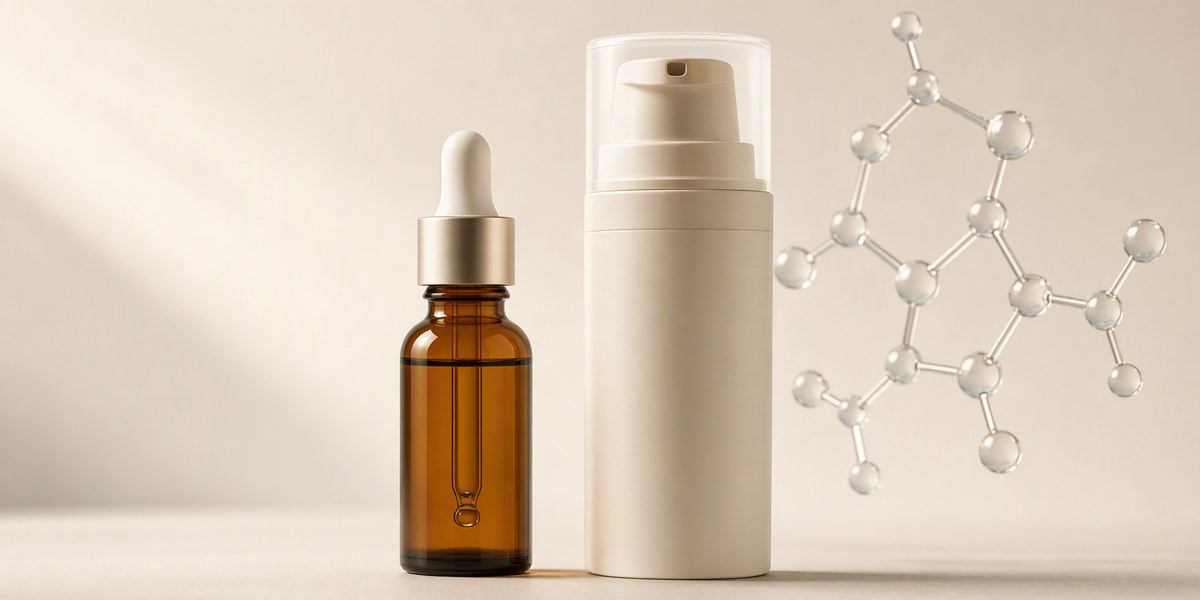
Retinol degrades when exposed to light, air, and heat, losing potency and potentially increasing irritation. A formulator protects it with encapsulation (liposome or cyclodextrin), antioxidant support such as vitamin E, and a pH in roughly the 5 to 6 range. Packaging is part of the formula: an opaque, airless pump preserves the active far better than an open jar. These choices are also a marketing asset — "encapsulated, airless-protected retinol" is a concrete, defensible claim.
The new EU vitamin A limits
The European Union has added retinol, retinyl acetate, and retinyl palmitate to the restricted list under Regulation (EU) 2024/996. The caps are 0.05% retinol equivalent in body lotions and 0.3% retinol equivalent in other leave-on and rinse-off products, and any product containing these ingredients must carry the label line "Contains Vitamin A. Consider your daily intake before use." The rules phase in from 2025 through 2027. Worth understanding: the EU’s scientific committee concluded cosmetic retinol is safe — the cap manages cumulative vitamin A intake from diet, supplements, and cosmetics combined. It is a margin-of-safety measure, not a finding that retinol harms skin. Other markets set their own rules, so confirm the limits for each destination before locking a formula.
Keep claims on the right side of the line
Claim boundaries differ by market, and the same wording can be cosmetic in one place and a drug claim in another. In the United States, retinol is a cosmetic, but positioning a product as an acne treatment crosses into drug territory. Safe ground is appearance language — the look of fine lines, smoother texture, more even tone, radiance. Avoid implying the product treats, cures, or prevents any condition.
Practical first steps for a brand
Decide the claim level and target markets first, because those select the retinoid form and the concentration ceiling. Ask your contract manufacturer how the retinol is stabilized and packaged, and confirm the concentration complies in each destination — especially the EU caps if Europe is in scope. Brief these constraints at the start, not after a formula is locked, and you avoid an expensive reformulation later.
CHONGSHENG FUTURE works with skincare brands on OEM and ODM development, including retinol-based lines. If you are scoping a retinol product, share your concept and target market and we can help map the form, concentration, stability, and compliance path.