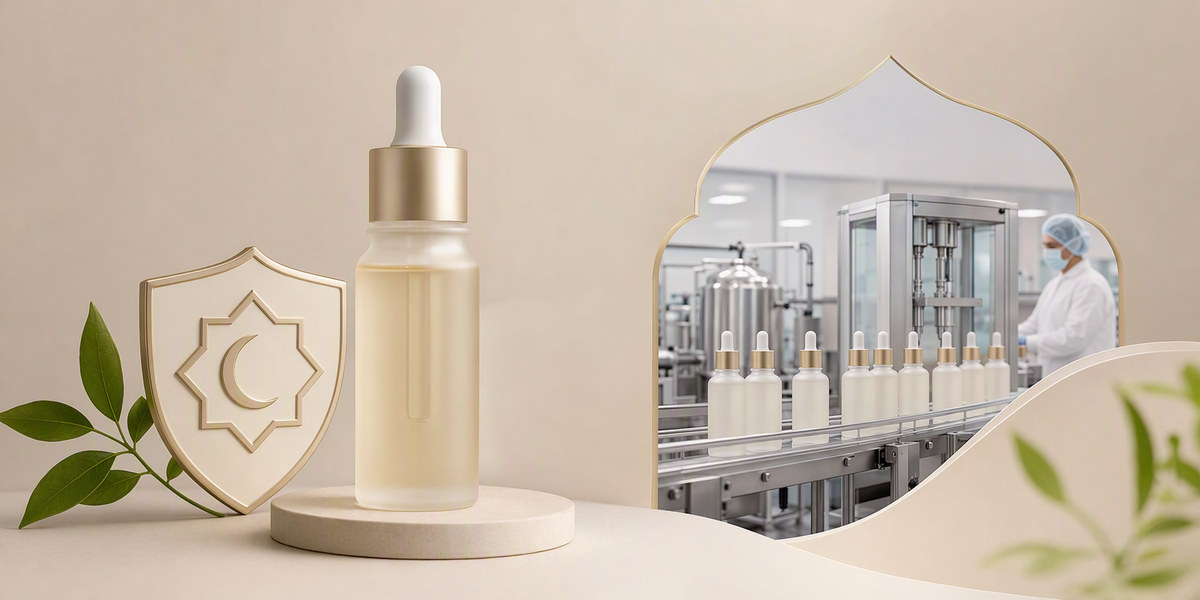
Halal cosmetics is one of the faster-growing positioning choices for skincare brands, especially those selling into Indonesia, Malaysia, the Gulf, and other Muslim-majority markets. But a halal label is not a marketing sticker — it is a set of formulation, sourcing, and manufacturing commitments that a certifier will audit. This article walks through what a brand, and its contract manufacturer, actually needs to put in place before applying.
What "halal" means for a cosmetic product
At the ingredient level, a halal cosmetic must be free from pork and porcine derivatives, blood, carrion, and human-derived ingredients. Animal-derived materials such as certain collagens, lanolin, or keratin must come from halal-slaughtered sources and be backed by documentation. Alcohol is the nuanced one: many certifiers permit small amounts of externally used ethanol while discouraging it, and fragrance is often reformulated alcohol-free. The rule extends to the whole chain — processing aids, cleaning agents, and even lubricants on the production line all fall within scope.
The ingredients most likely to need a swap
Most conventional formulas can be made compliant with a short list of substitutions:
- Collagen — conventional sources are often bovine or porcine. Marine (fish) collagen or plant-based collagen boosters such as peptides and vitamin C are common alternatives.
- Carmine (CI 75470) — a red pigment from cochineal insects. Replace with iron oxides, titanium dioxide, or mica.
- Squalene — traditionally from shark-liver oil. Plant squalane from olive or sugarcane performs the same role.
- Glycerin and stearic acid — these can be animal or plant derived. Verify a vegetable source such as palm, coconut, or soy.
- Lanolin — a sheep-wool emollient generally accepted, though stricter interpretations require a halal-slaughtered source. Confirm with your certifier.
Manufacturing and line controls
Certification rests on a Halal Assurance System (HAS) built on good manufacturing practice such as ISO 22716. The practical requirements are segregation and traceability: a dedicated halal line, or a validated cleaning protocol (often called sertu or dibagh) between halal and non-halal runs with documented line-clearance; separate storage for halal raw materials and finished goods; and supplier halal certificates or declarations for any animal-derived material, supported by full traceability documents such as certificates of analysis.
The certification process, step by step
First, choose a recognized certifier for your target market — Malaysia’s JAKIM (standard MS 2200), Indonesia’s BPJPH or MUI, Singapore’s MUIS, the GCC/GSO framework, Saudi SFDA, or UAE ESMA, with bodies such as IFANCA or HQC extending reach further afield. You then submit a product list, the full formula, a process flow, facility layout, sanitation procedures, and label mockups. After document review and an on-site audit, you receive a certificate subject to annual surveillance and re-certification. Worth noting: in many Middle East markets certification is not legally mandatory for cosmetics, but it remains a strong trust and retail-channel signal for Muslim consumers.
Is it worth the effort?
Several market-research firms estimate the global halal cosmetics market at roughly 42 to 47 billion US dollars in 2024, projecting toward 115 to 125 billion by the early 2030s at a compound annual growth rate around 11 to 12 percent, with skincare typically the largest segment. These are vendor and agency estimates, not independently verified figures, so treat them as directional rather than exact. The positioning also reaches beyond Muslim consumers: the "cleaner, more transparent, ethically sourced" message resonates with mainstream buyers as well.
Practical first steps for a brand
Decide your target markets first, because that selects your certifier. Audit your formula against the swap list above, brief your contract manufacturer on line segregation and cleaning evidence early, and build the supplier documentation pack before you apply. Starting the compliance conversation at the brief stage is far cheaper than reformulating after a formula is locked.
CHONGSHENG FUTURE works with skincare brands on OEM and ODM development, including halal-positioned lines. If you are scoping a product for Indonesia, Malaysia, or the Gulf, share your concept and target market and we can help map the formulation and certification path.