Ceramides are one of the most talked-about ingredients in modern skincare, yet they are also one of the most misunderstood. In a formula they act as structural lipids that help maintain the skin’s moisture barrier and keep the surface feeling comfortable. They are not a water-soluble active you can simply stir into water — they are fatty molecules that need deliberate formulation to stay stable and to perform. This guide explains what ceramides do, which types you will meet, and the practical trade-offs a brand should weigh before building a "barrier" or "moisturizing" product around them.
What are ceramides, in plain terms?
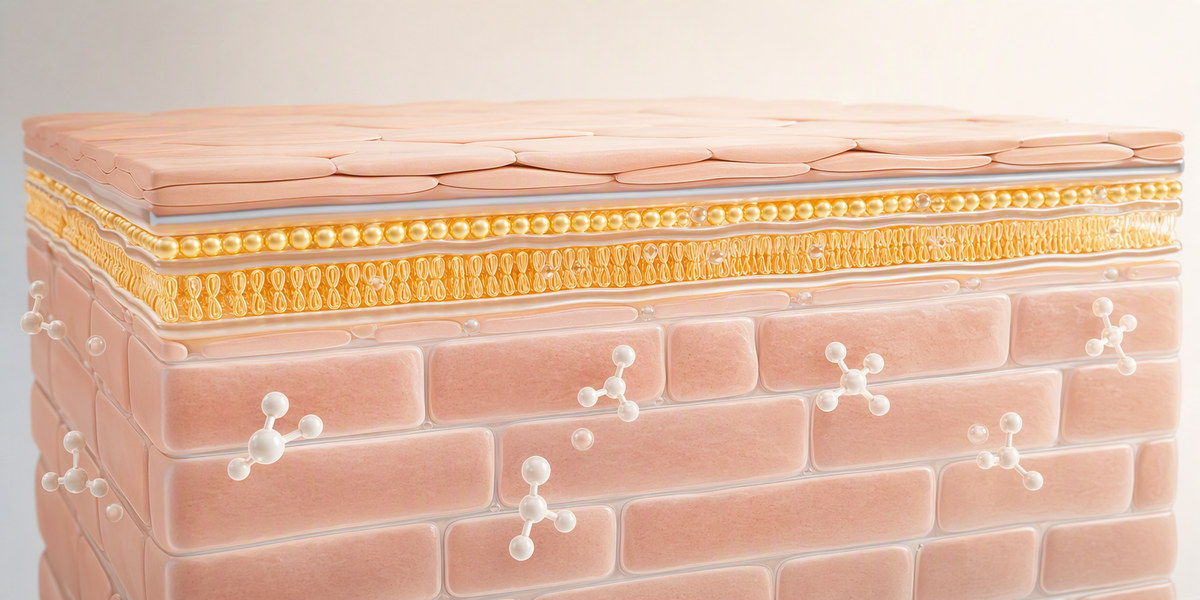
Ceramides are a family of sphingolipids that occur naturally in the stratum corneum, the skin’s outermost layer. Picture the barrier as a brick wall: the corneocytes are the bricks, and the intercellular lipids are the mortar holding them together. Ceramides are the largest share of that mortar. Along with cholesterol and free fatty acids, they form an organized lipid matrix that helps the skin hold moisture and stay cohesive. Commonly cited research places ceramides at roughly half of those intercellular lipids, with cholesterol around a quarter and free fatty acids making up much of the rest — but the exact split varies by study, so treat it as an indicative reference rather than a fixed rule.
What do they actually do inside a formula?
At the formulation level, ceramides contribute to the product’s barrier-support and emollient positioning. When dispersed properly, they help the formula maintain the skin’s moisture barrier and reduce transepidermal water loss (TEWL), the passive evaporation of water through the skin. The practical result is usually a more comfortable, less tight-feeling surface and a product story built around resilience and hydration. It is important to keep the wording at the appearance and comfort level: ceramides support the barrier rather than acting as a treatment for any skin condition. How far a brand can go in its claims depends on the market, which we cover near the end.
Which ceramide types show up in cosmetics?
Skin naturally contains a dozen or more ceramide subclasses, and cosmetic ingredient labels tend to name a handful: Ceramide NP, AP, EOP, NS, NG and EOS are common (you may also see an older numbering, Ceramide 1 through 6 or 9). Each has a slightly different structure, but the useful takeaway for a formulator is not to crown a single type as the answer — it is that ceramides work as a system. Multi-ceramide blends that better mimic the skin’s own lipid profile are a frequent choice, because the balance between types, and between ceramides, cholesterol and fatty acids, influences how the lipid layers organize. A single hero ceramide, on its own, is rarely the whole story.
Why are ceramides tricky to formulate?
This is where many first-time barrier formulas run into trouble. Ceramides are highly lipophilic and essentially insoluble in water, with a high melting point. If they are not dispersed carefully, they can recrystallize during storage, which may show up as graininess, stability drift, or simply an active that sits in the jar instead of integrating into the emulsion. Getting a uniform dispersion typically means melting the ceramide into the oil phase at an elevated temperature, using high-shear or homogenization, and choosing emulsifiers that are friendly to lamellar structure. Long-chain fatty alcohols such as cetyl or stearyl alcohol are often included because they help prevent crystal nucleation.
How do formulators make them stable and usable?
Several strategies address the solubility and deposition problem. Liposomal or encapsulated ceramide raw materials, biomimetic lipid complexes, pre-dispersed ceramide blends and cyclodextrin carriers are all used to keep the active solubilized and bioavailable. Just as important is the ratio: pairing ceramides with cholesterol and free fatty acids, rather than ceramide alone, mimics the skin’s natural composition far better. pH is another quiet factor — a skin-compatible acidic-to-near-neutral range, commonly cited around 4.5 to 6.5, is typical, and the full system should be checked for compatibility if you combine ceramides with acid actives. None of this is guesswork: it is validated during stability and compatibility testing before a formula goes to market.
What concentration should you expect?
There is no single "right" percentage, and more is not automatically better. For daily leave-on products, total barrier-lipid content (ceramides plus cholesterol plus fatty acids) in the roughly 1 to 5 percent range is common, while many biomimetic blends keep total ceramides below 1 percent. What matters more than a headline number is the ratio of the lipids to each other and the delivery system that carries them. The precise figure always depends on the raw material, the emulsion and the product concept, so confirm with your supplier and verify through testing rather than copying a number from a competitor’s label.
What pairs well with ceramides?
Ceramides rarely work alone in a well-rounded formula. Humectants such as glycerin and hyaluronic acid draw and hold water; niacinamide and panthenol are frequently added for a soothing, comfort-oriented profile; lightweight emollients such as squalane help fill the micro-gaps between lipid sheets and improve sensory feel. The goal is a formula where each component addresses a barrier function the ceramide alone cannot — hydration from humectants, calming from panthenol, structure from the lipid matrix.
Where do the claim lines sit?
This is the part brands most often get wrong. Ceramides sit firmly in the cosmetic space when the language stays at "helps maintain," "supports" and "improves the appearance of." The moment a claim implies addressing or preventing a skin condition, the product may cross into a different regulatory category that requires different evidence and approvals. Those lines are not the same everywhere — what is permissible for a cosmetic in one market may be restricted in another. If you plan to make hydration or barrier-support claims, the substantiation (in-vitro, instrumental TEWL or hydration testing, or clinical data) should match the claim and the target market’s rules. Treat compliance as a design input, not an afterthought.
Building a ceramide product with a manufacturing partner
For a brand, the practical question is less about naming one ceramide as the winner and more about how we get a stable, claim-appropriate, good-feeling product to market. A capable OEM/ODM partner can help you choose between a stock ceramide blend and a custom lipid system, select the right delivery format, set a realistic concentration for your texture and budget, and run the stability and compatibility work that turns a concept into a shippable formula. If you are planning a barrier-focused line, bring your target market and claim intent to the table early — it shapes the entire formulation brief.
CHONGSHENG FUTURE works with skincare brands on OEM and ODM development, including ceramide-based barrier and moisturizing formats. If you are scoping a new product, share your concept and target market and we can help map the formulation and testing path.