A contract manufacturer’s minimum order quantity (MOQ) is one of the first numbers a skincare founder meets, and one of the most misunderstood. In short, MOQ is the smallest batch a factory will produce for a single product per production run. It is not a fixed industry standard. It is set by each manufacturer, and it shifts with the product format, the packaging you choose, and how the line is configured. Understanding what sits behind that number helps you price a launch, manage cash flow, and avoid committing to inventory you cannot sell.
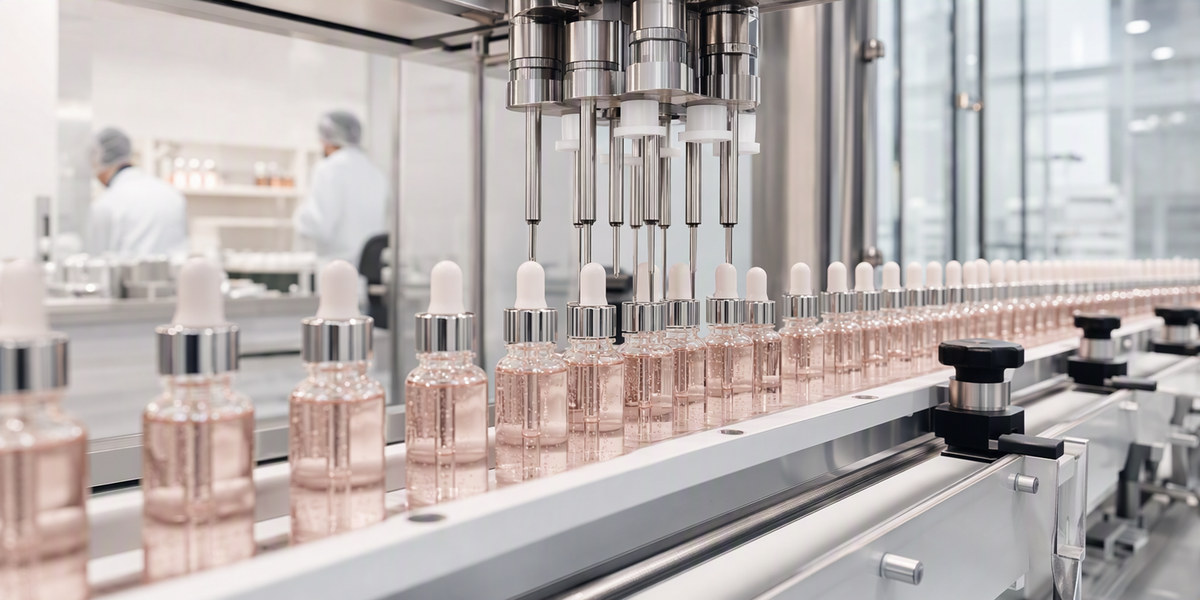
What does MOQ actually mean in cosmetics manufacturing?
MOQ stands for minimum order quantity. For a cosmetics contract manufacturer, it is the lowest unit count they will accept to set up and run a batch of one SKU. Below that volume, the line changeover, cleaning, and quality paperwork cost more than the order is worth. MOQ is usually quoted per SKU rather than per mixed order, so a range of three shades or three formulas means three separate minimums unless the supplier bundles them.
What drives a manufacturer’s minimum order quantity?
Several factors push the number up or down. The filling and emulsification equipment has a setup cost that is amortized across the batch, so very small runs are inefficient. Raw-material suppliers themselves often sell with minimums, which the manufacturer passes through. Stability testing and microbial challenge testing are normally run on a representative batch; their cost is easier to justify on larger volumes. Regulatory documentation and batch records also scale with the run.

How does product format change the MOQ?
Format matters more than many founders expect. Simple liquid serums and toners are often easier to fill and sit at the lower end of a supplier’s range. Emulsions such as creams and lotions need homogenization and tighter process control, which can raise the practical minimum. Sheet masks, sachets, and single-dose ampoules are frequently priced per pack and negotiated separately. Products that require a custom-molded bottle or jar introduce tooling, and tooling almost always lifts the minimum commitment because the mold cost must be recovered.
Stock packaging vs custom packaging: why it matters for MOQ
This is the lever founders control most directly. Stock or off-the-shelf bottles, jars, and tubes, the ones a supplier already carries, keep MOQs low because there is no tooling and no print setup. Custom packaging, whether a new mold or bespoke printing and decoration, raises both the MOQ and the lead time. If a low entry volume is the priority for a first launch, starting with stock packaging and moving to custom later is a common path.

How does MOQ affect your unit cost and inventory risk?
MOQ and unit price move in opposite directions. A larger batch spreads setup, testing, and tooling across more units, so the per-unit cost falls. A smaller batch keeps your cash tied up in less inventory but costs more per piece. The trade-off is not only financial: a high MOQ means more product sitting in a warehouse before you know it sells. The right volume is the one that matches your sales forecast and working-capital comfort, not the one with the lowest headline price.
Do MOQs differ by region or manufacturer type?
They do, and the differences are worth checking rather than assuming. Some Asian contract manufacturers built their export business around lower entry volumes for indie and emerging brands, while many European and North American labs set higher minimums tied to their line economics and regulatory support. These are tendencies, not rules. A supplier’s MOQ depends on its equipment, its existing catalogue of stock packaging, and the markets it serves. Confirm the actual number with each candidate.
What should you confirm with a supplier before agreeing to an MOQ?
- Is the MOQ per SKU or per combined order, and does it include a trial or sample batch?
- What is the lead time at that volume, and does it change for custom packaging?
- Are stability and challenge-test batches separate from the sellable batch, and who owns that cost?
- Do labeling and artwork have their own minimums independent of the formula MOQ?
- Are there volume breaks where the per-unit price steps down as quantity rises?
How can a new brand negotiate a workable MOQ?
If a quoted minimum feels too high for a first launch, a few moves help. Consolidate your initial range so you are not committing to many separate minimums at once. Choose stock packaging to avoid tooling. Share a credible repeat-order plan so the supplier can justify a lower first run. Phase your launch across fewer SKUs, then scale the ones that sell. None of these removes the minimum, but together they bring the entry volume closer to what a new brand can carry.
Working with a manufacturing partner on batch size
A good contract manufacturer talks through batch size as part of the brief rather than quoting it in isolation. At CHONGSHENG FUTURE (重生未来), the OEM and ODM team works with emerging and established skincare brands to match formula, packaging, and order volume to a realistic launch plan, including flexible batch options for brands testing a new market. If you are scoping a first production run, it is worth a conversation about what volume actually fits your forecast before you commit.