Sustainable skincare packaging is not a single material you switch to — it is a set of trade-offs between recycled content, refillability, recyclability and cost. A brand should know which lever its product actually needs, confirm the formula works with the chosen material, and understand what an environmental claim requires before committing to tooling.
The topic keeps surfacing for a practical reason. Retailers and tender requirements in several markets now ask suppliers for packaging credentials, and buyers increasingly screen partners on material choices. That does not change the fundamentals below, but it raises the cost of getting a claim wrong, so the decisions are worth making early.

What does sustainable skincare packaging actually mean?
There is no single legal definition of "sustainable" for cosmetics packaging. In practice the term bundles several different choices that each reduce environmental impact at another point in the product lifecycle: the material used, how much material is used, whether the pack is refillable, how easily it can be recycled, and whether it contains recycled content. Because these are separate levers, a brand usually has to decide which one its product and story genuinely need rather than chasing all of them at once.
Which packaging levers actually reduce impact?
The realistic options a brand can choose between are material strategies, not marketing slogans. Each changes the pack in a different way, and the list below covers the choices that most affect cost and claim risk:
| Lever | What it does | Main trade-off |
|---|---|---|
| PCR content (recycled PET/HDPE/PP) | Replaces part of the virgin plastic with post-consumer recycled resin | Achievable percentage depends on the part and contact rules; needs documentation |
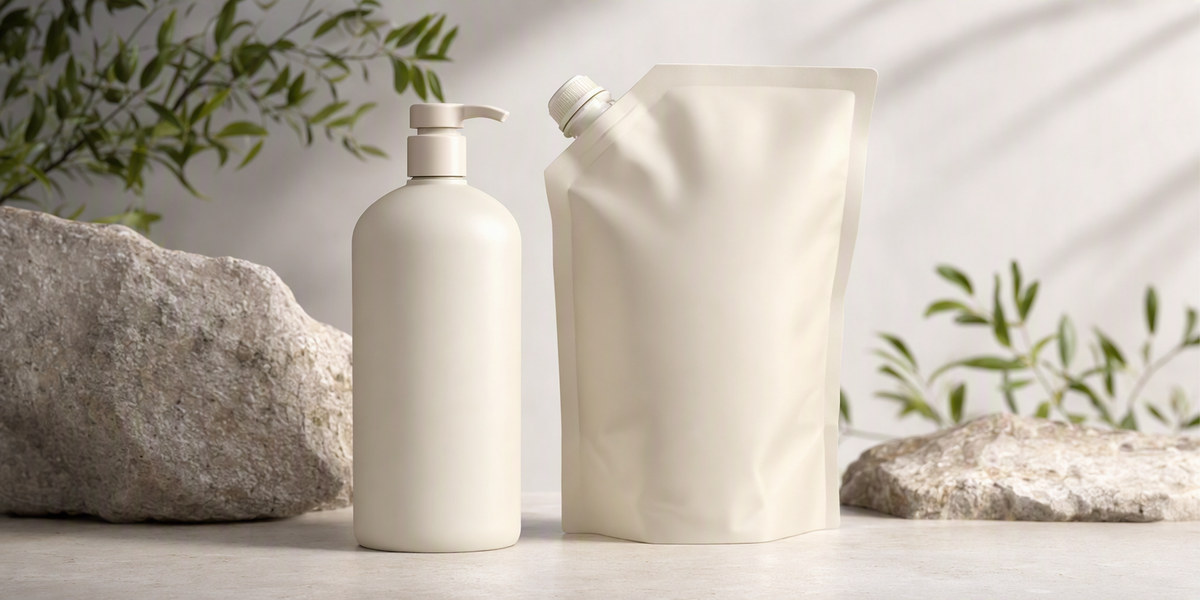
| Refill system (pouch or cartridge) | Uses less material per use than a rigid bottle | Adds a second SKU and a consumer step |
| Mono-material design | Builds the pack from one resin so it sorts cleanly for recycling | Harder for multi-layer barrier needs |
| Glass or aluminum | Widely recyclable, premium feel (glass) or light weight (aluminum) | Glass is heavier to ship; aluminum often needs an inner lining |
Post-consumer recycled (PCR) content is normally expressed as a percentage, and brands commonly set targets of 30% or more, depending on the material and component. The level that is both achievable and acceptable varies with the application, cosmetic-contact requirements and local rules, so it should be treated as a target to confirm, not a fixed number.

Will the formula work with the material you choose?
Product compatibility should come before material preference. Some active ingredients interact with certain plastics or need a barrier layer to hold stability, and not every formula suits every pack. Whether a material is "greener" is irrelevant if it lets the product degrade or change in the bottle. Material–formula compatibility usually needs to be checked through stability or compatibility work on the actual formulation, not assumed from a supplier’s brochure. Where the formula is sensitive, a conservative material choice can protect the product even if it looks less ambitious on paper.
What do environmental claims require before you print them?
This is where brands get caught out most often. Statements such as "recyclable," "compostable," or "made with recycled material" are treated as claims in many markets — for example, the US FTC Green Guides and the EU’s green-claim rulemaking set expectations for how such claims are supported. Vague terms like "eco-friendly" are the riskiest because they are the hardest to substantiate. The practical rule is simple: only print an environmental claim you can support with evidence, and confirm the applicable requirements for each target market before artwork is finalized, because the rules vary by region.
How do MOQ, lead time and cost change with sustainable options?
Custom sustainable packaging often carries a higher minimum order quantity and a longer lead time than standard stock components, because tooling and material sourcing are less standardized. Stock sustainable options are usually faster and lower-MOQ but give less differentiation. On cost, sustainable formats can sit above conventional plastic per unit, but the gap depends on material, volume and resin price; PCR resin in particular tracks recycled-feedstock availability, so treat any number as a planning range rather than a fixed quote.
Traceability matters here. If a brand claims a specific PCR content, it should be able to show documentation — commonly a certificate of recycled content — and a verifiable chain back to the supplier. Asking for this early avoids a claim that cannot be defended later.
What should you ask a manufacturing partner before committing?
Before locking tooling, a brand benefits from clear answers to a short list of questions:
- Which materials are compatible with this specific formula?
- What PCR percentage is realistic for this part, and what document supports the claim?
- What is the MOQ and lead time for custom versus stock sustainable options?
- Can the pack be designed mono-material to improve recyclability?
- What substantiation does the chosen market require for the claim, and who prepares it?
Refill and recycling only deliver their benefit if consumers actually take part, so on-pack instructions and a clear refill or take-back story matter as much as the material itself.
If you are scoping a skincare line and want to pressure-test a sustainable packaging route against real formulation, MOQ and claim-substantiation constraints, our technical team can review the options with you before any tooling is committed.