Freeze-dried skincare, also known as lyophilized skincare, is a two-component format that stores cosmetic actives as a dry powder or cake separate from a liquid vehicle, combining them only at the point of use. The format makes sense when your active ingredient genuinely loses activity in water over time, but it adds packaging complexity and cost — so the decision should be driven by stability data, not by marketing appeal alone.
What Is Freeze-Dried Skincare?
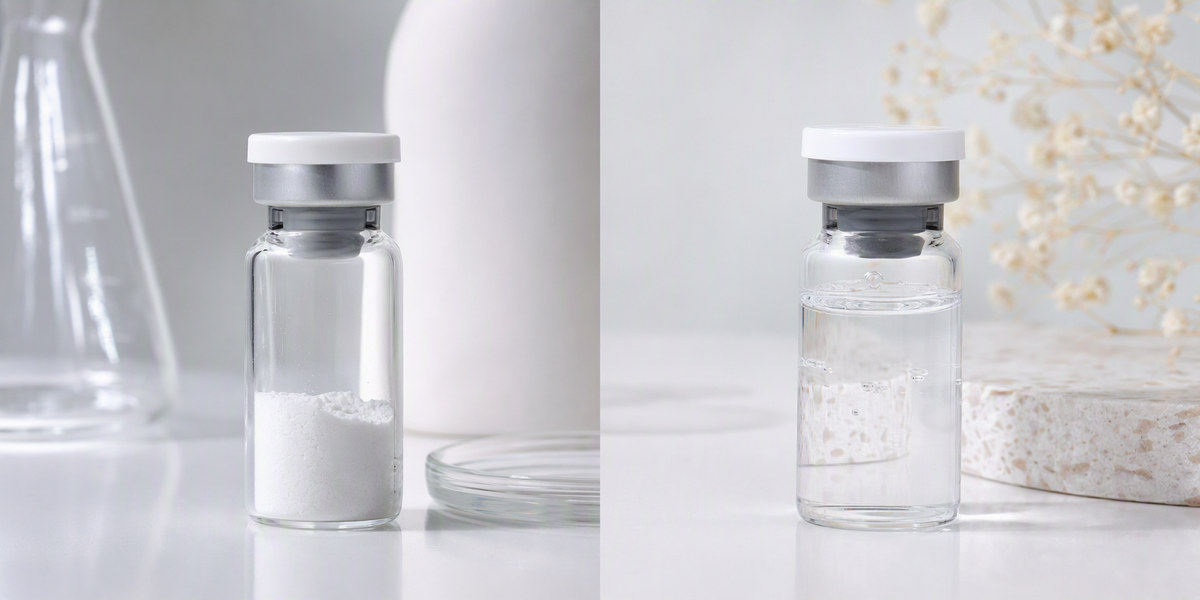
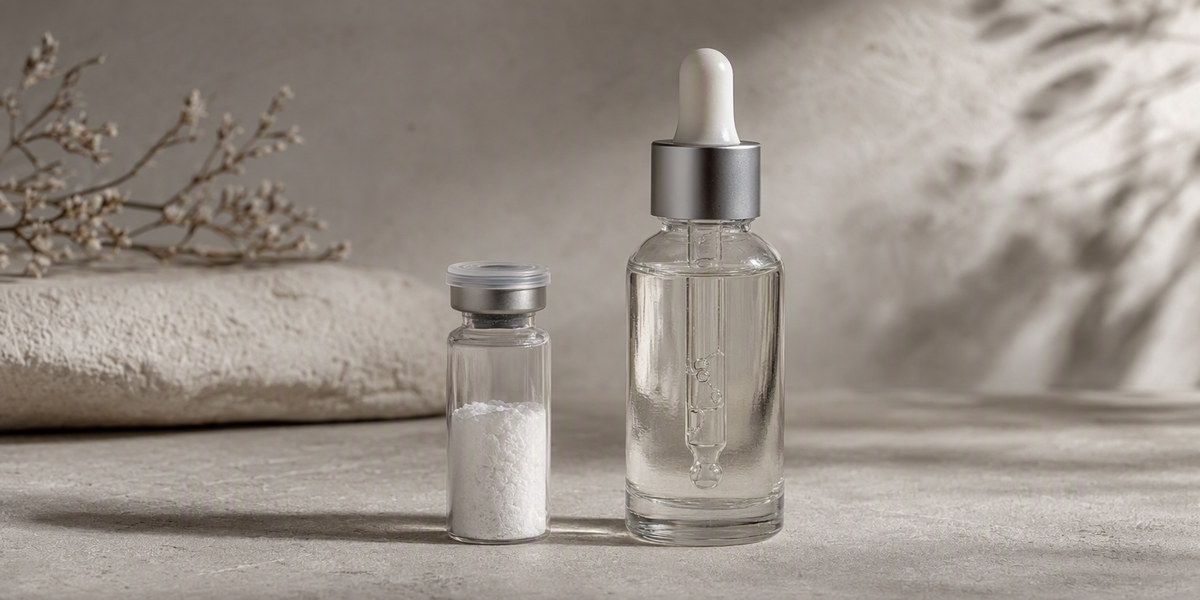
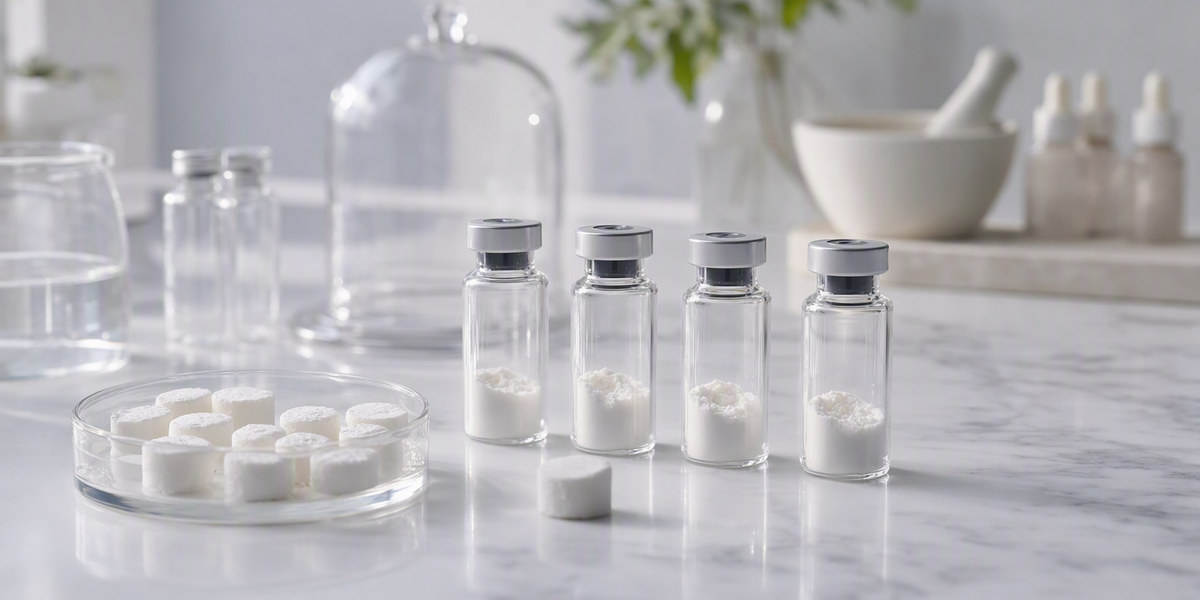
A freeze-dried skincare product ships as two parts: one chamber holds the active in dry form (a powder, porous cake or tablet), and another holds the liquid base (a serum, buffer or solvent). The user mixes them at home — pressing a pod into an ampoule, pouring liquid into a vial, or dissolving a tablet — and then uses the reconstituted product within a defined window. Once mixed, the product behaves like any other water-containing cosmetic: its usable life depends on the preservative system, storage conditions and formula design.
How Does Freeze-Drying Actually Work?
The process behind freeze-dried skincare is lyophilization, an established industrial method used across regulated industries such as pharma, food and cosmetics. In practice it works in three steps:
- Freezing: the aqueous solution containing the active is frozen solid, typically at low temperature.
- Primary drying (sublimation): pressure is reduced under vacuum, and controlled heat is applied so the ice turns directly into water vapor without passing through a liquid phase. This removes the bulk of the water.
- Secondary drying: residual bound moisture is removed under further vacuum and gentle heating, leaving a stable dry solid with very low water content.
The result is a porous structure that can be quickly reconstituted when liquid is added. For cosmetics, this means the active sits essentially "paused" until the user activates it.
Why Keep the Active Separate from the Liquid?
The core reason is formulation stability. Some cosmetic raw materials degrade, oxidize or lose potency when stored dissolved in water for months at ambient temperature. Keeping them dry until use can help preserve their original state and often supports a longer shelf life for the unmixed product. This is particularly relevant for certain categories of materials:
- Certain peptides that are sensitive to hydrolysis or oxidation in solution.
- Enzyme-based or probiotic-derived ingredients whose biological activity can decline in aqueous storage.
- Some vitamin C derivatives that are less stable in water than in dry form.
- PDRN used in topical cosmetic formulations — note that in skincare PDRN functions as a cosmetic raw material; the freeze-dried format protects its stability during storage but does not change claim boundaries, and any efficacy claims must remain within cosmetic scope and be appropriately substantiated per market rules.
Conversely, many common actives — niacinamide, hyaluronic acid, glycerin, most emollients and standard colorants — are already stable in conventional water-based formulas. Drying those adds cost without delivering a meaningful stability benefit.
Which Products Benefit from the Format?
The table below summarizes where freeze-dried format tends to add value versus where a conventional single-chamber serum is usually sufficient:
| Dimension | Freeze-Dried / Two-Component | Conventional Serum | |
|---|---|---|---|
| Active storage | Dry, separated from liquid | Dissolved from day one | |
| Suited for | Water- or heat-sensitive actives | Stable actives (niacinamide, HA, glycerin) | |
| Packaging | Dual-chamber vial, pod-in-ampoule, tablet-in-bottle | Standard bottle, dropper or pump | |
| Typical unit cost | Higher (packaging-driven) | Lower | |
| User routine | Mixing step required | Ready to apply | |
| Dry shelf life | Often longer | Set by formula and preservation system |
When Does the Format NOT Make Sense?
There are clear cases where freeze-dried format adds expense without a corresponding technical benefit:
- Your active is already stable in water. If accelerated stability data shows no meaningful degradation over the target shelf life, drying is unnecessary.
- You need the lowest possible unit cost. Dual-chamber packaging and aseptic filling raise per-unit costs compared to a standard bottle fill.
- Your brand positioning emphasizes simplicity. A mix-at-home step can reduce routine compliance for some consumer segments.
- You cannot support extra testing. Both the dry component and the reconstituted product need stability and microbiological assessment, which adds time and lab cost.
What Should You Ask Your OEM/ODM Manufacturer?
If you are evaluating whether freeze-dried format fits your next SKU, these questions help you get past generic answers:
- Which specific actives actually benefit from dry storage in my formula? Ask for the stability rationale, not a blanket recommendation.
- What is the usable window after reconstitution, and what does it assume about storage? Clarify whether it is days, weeks or months, and whether refrigeration is expected.
- What packaging options exist, and how does each affect MOQ and lead time? Dual-chamber glass vials, pods and tablets each have different tooling and minimum-order implications.
- What stability and microbiological work is needed for both the dry and reconstituted states? Understand the testing scope before committing to the timeline.
- How do claim requirements in my target market address this format? The freeze-dried delivery system itself does not grant special claim rights; substantiation still applies per EU, US, China or regional rules.
If you are scoping a private label line and want to assess whether a freeze-dried format is technically justified for your target actives and market position, our technical team can review your brief against real production constraints before sampling.