The Middle East skincare market looks for a supplier that can clear Gulf market-entry requirements, support halal-sensitive positioning, handle flexible order sizes, and deliver private-label products on a predictable logistics timeline. Beyond price, buyers are really screening for a manufacturing partner that lowers their regulatory and supply-chain risk.

Who buys skincare from suppliers in the Middle East?
The Gulf Cooperation Council (GCC) covers six markets — Saudi Arabia, the United Arab Emirates, Qatar, Kuwait, Oman and Bahrain — and buyers there fall into three practical groups, each with different expectations.
- Regional distributors and importers place larger, recurring orders and often re-export through hubs such as Dubai. They care about supply continuity, documentation, and a partner who can scale with them.
- Modern retail and pharmacy chains, including beauty retailers and e-commerce platforms, source private-label or exclusive lines. They need shelf-ready packaging and reliable fulfillment.
- Emerging local and regional brands — Gulf-based entrepreneurs and family businesses — usually need a lower entry order quantity, private-label support, and a fast route to market.
What does halal certification mean for a GCC buyer?
Halal status is frequently requested for the GCC skincare market, but it is not a single uniform legal mandate across every country. In some markets it is treated as a market-access expectation; in others it is a commercial preference driven by consumer demand. A capable supplier should be able to provide recognized halal documentation and, where required, formulate without animal-derived or alcohol-based ingredients.
For the buyer, the practical question is not "do you have a certificate" but "which certifying body is accepted in my target market, and can you support the full product range?" Confirming this early avoids a reformulation or re-labeling cycle later.
How does Gulf regulation shape supplier requirements?
GCC markets commonly apply a Gulf Technical Regulation for cosmetic products issued through the GSO (GCC Standardization Organization). It covers areas such as ingredient restrictions, labeling — often requiring Arabic alongside English — a responsible-person or notification model, and rules on prohibited or substantiated claims. Conformity and correct labeling are practical entry requirements, though exact obligations differ by product and member state.
A supplier’s value here is documentation discipline: accurate ingredient declarations, claim review against the destination market, and artwork that meets local labeling rules. Treat regulation as a checklist owned jointly with your manufacturer, not as a last-minute hurdle.
Why does MOQ flexibility matter for new brands?
The realistic minimum order quantity is driven by batch economics, packaging configuration, and component purchasing — not by the formula itself. Custom packaging usually creates a higher MOQ than standard stock options.
This matters because the two main buyer types need opposite things: distributors can absorb larger batches, while a new local brand usually wants to test demand with a smaller first run. A supplier that offers tiered MOQ paths, or stock packaging that lowers the entry volume, removes one of the biggest barriers for first-time brand owners in the region.
What private-label capability should a supplier offer?
Private label means taking a buyer’s concept — or a ready base formula — to a finished, branded SKU. The capability buyers should check includes:
- Formulation support, from adapting an existing base to developing a custom product.
- Packaging and artwork coordination, including market-appropriate, modest and heat-stable options.
- Full documentation: Certificate of Analysis (COA), a product information or technical dossier, and stability and preservative-efficacy testing where relevant.
- Clear rules on formula ownership and usage rights, defined in the manufacturing agreement.
How does the regional climate drive formulation choices?
High solar UV exposure across the Middle East sustains steady demand for sun protection and for daily products that pair protection with lightweight textures. High humidity in coastal Gulf states pushes buyers toward non-greasy, fast-absorbing, humidity-resistant emulsions that stay stable in heat.
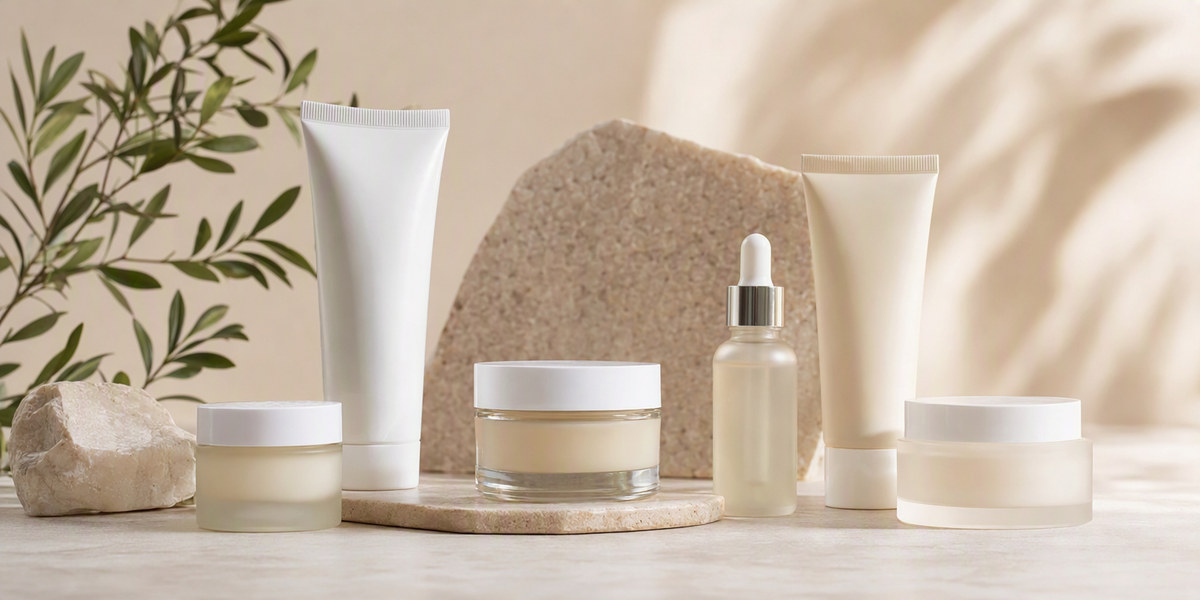
Heat during storage and transit makes thermal stability and an appropriate preservation strategy relevant. The right approach depends on the formulation, water content, packaging, and intended shelf life — there is no single "heat-proof" formula, only a well-documented one.
What logistics and documentation should you check before signing?
Logistics is where many launches slip. The largest variable is often component and packaging lead time, not the filling step itself. Use the table below as a pre-signing check.
| Area | What to verify | Why it matters for the GCC |
|---|---|---|
| Certifications | Halal path and accepted certifying body | Varies by target market; confirm before formulation |
| Regulatory | GSO conformity, Arabic labeling, claim review | Practical entry requirement; differs by member state |
| MOQ | Tiered or stock-packaging options | Lets new brands enter without overcommitting |
| Lead time | Component/packaging critical path | Usually the longest step in the schedule |
| Logistics | Air/sea readiness, free-zone re-export | Dubai and other hubs serve wider MENA |
| Documents | COA, technical dossier, test data | Needed for clearance and retail onboarding |
If you are scoping a private-label or contract-manufacturing project for the Gulf, the useful first step is to share your target markets, intended certifications, and realistic first-order volume with a manufacturing partner. CHONGSHENG FUTURE works across skincare OEM and ODM programs and can review your brief against real production and regulatory constraints before sampling begins.